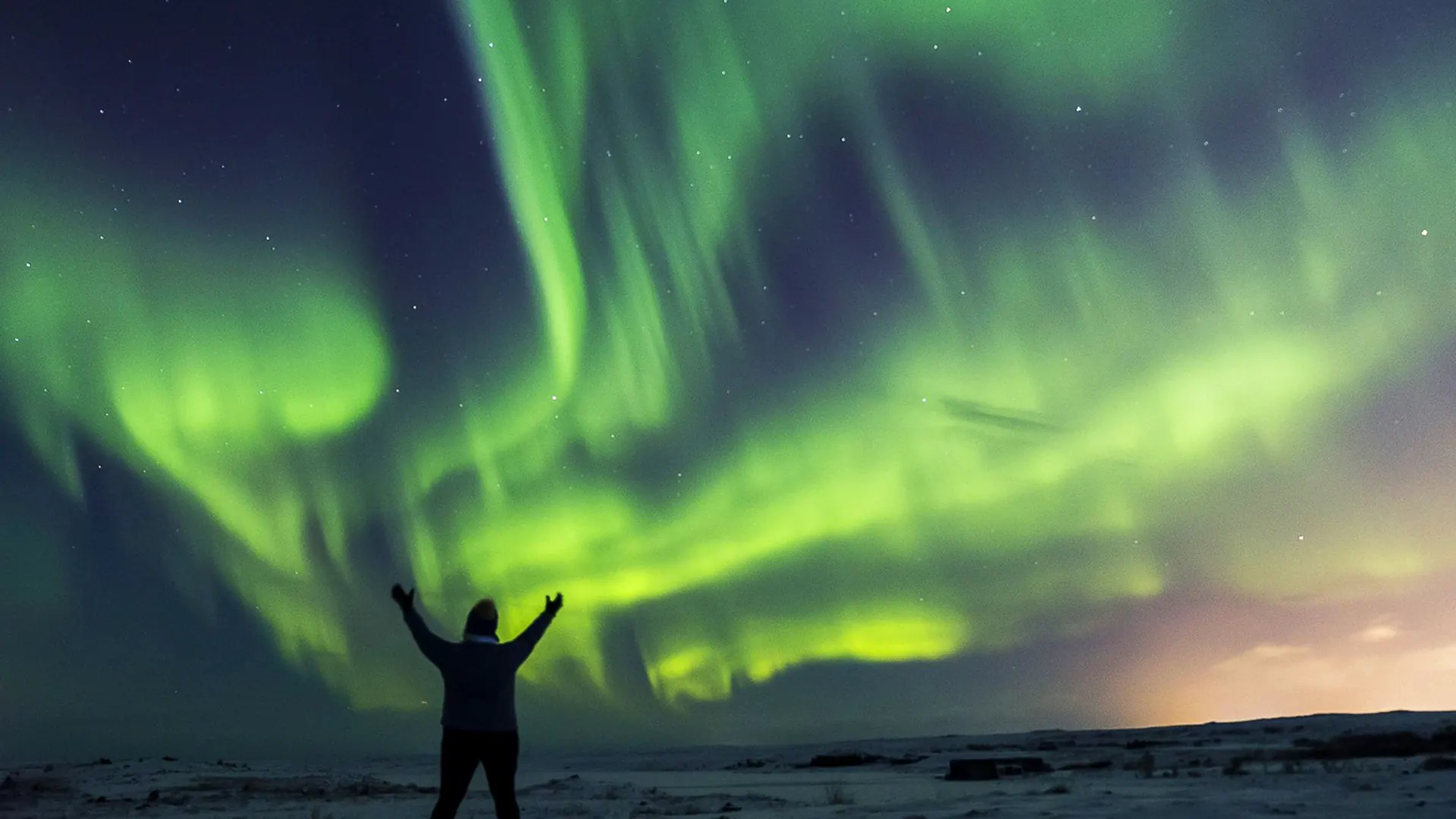
Data and prices checked October 2026
Northern Lights Destinations, Compared on Darkness, Cloud and Tours
Ten places under the auroral oval, ranked on what decides your chances, how long and how clear the nights are, with the tours you can book in each.
The Destinations, Compared
Pick the Place That Fits Your Trip
One page for each place where a northern lights tour is worth booking, with the aurora data, the tours compared and what you can do on your own.
Northern Lights in Iceland
Reykjavik's buses, minibuses and yacht, with a free retry on the most-booked tours.
Compare the Reykjavik tours →Tromsø or Abisko?
The most tours in the world, on the cloudiest coast, against the clearer valley across the Swedish border.
Compare Tromsø and Abisko →Abisko and Kiruna
The clearest sky in Scandinavia on our measure, with tours from Kiruna from about US$32.
Compare the Abisko tours →Rovaniemi Northern Lights
Guarantee tours: no aurora on the guide's camera, your money back.
Compare the Rovaniemi tours →Levi and Saariselkä
Ski resorts further north, with a small group that drives until the lights appear.
Compare the Levi tours →Alta
Under the oval at the head of a fjord, with a little more clear sky than Tromsø.
Compare the Alta tours →Lofoten
Peaks, beaches and photographer-guides, from Svolvær.
Compare the Lofoten tours →Yellowknife
The clearest winter sky on this site, with cabins and lodges to wait in.
Compare the Yellowknife tours →Alaska
Fairbanks chases, the Arctic Circle and Chena Hot Springs.
Compare the Alaska tours →Northern Lights in Norway
Tromsø, Alta and Lofoten side by side, and why the tours start in the north.
Compare Norway →Northern Lights in Finland
Rovaniemi, Levi and Saariselkä, and the guarantee tours.
Compare Finland →Northern Lights in Canada
Yellowknife against Whitehorse on clear sky and darkness.
Compare Canada →Pick your month
Where to See the Northern Lights, Month by Month
Each destination ranked for the month by its clear dark hours a night: hours of darkness times the share of cloud-free night sky. Darkness computed with JPL DE421; night cloud from NASA POWER, 2001 to 2025; Kp from GFZ, 2015-01-01 to 2025-12-31; checked October 2026. Averages, not a forecast.
| # | Destination | Clear dark hours (est.) | Dark hours | Night cloud | Dark hours with Kp 3+ | Tours |
|---|---|---|---|---|---|---|
| 1 | Yellowknife (Canada) | 2.8 h | 7.7 h | 63% | 25% | Check dates → |
| 2 | Fairbanks (Alaska) | 2 h | 7.2 h | 72% | 24% | Check dates → |
| 3 | Rovaniemi (Finland) | 1.9 h | 6.7 h | 71% | 29% | Check dates → |
| 4 | Levi and Saariselkä (Finland) | 1.7 h | 6.3 h | 73% | 29% | Check dates → |
| 5 | Iceland (Reykjavik) | 1.5 h | 7.3 h | 79% | 30% | Check dates → |
| 6 | Abisko and Kiruna (Sweden) | 1.3 h | 6.1 h | 79% | 30% | Check dates → |
| 7 | Alta (Norway) | 1.2 h | 5.4 h | 78% | 29% | Check dates → |
| 8 | Lofoten (Norway) | 1.1 h | 6.2 h | 82% | 30% | Check dates → |
| 9 | Tromsø (Norway) | 1 h | 5.6 h | 81% | 30% | Check dates → |
| # | Destination | Clear dark hours (est.) | Dark hours | Night cloud | Dark hours with Kp 3+ | Tours |
|---|---|---|---|---|---|---|
| 1 | Iceland (Reykjavik) | 2.4 h | 10.8 h | 78% | 27% | Check dates → |
| 2 | Fairbanks (Alaska) | 2.4 h | 10.8 h | 78% | 22% | Check dates → |
| 3 | Yellowknife (Canada) | 2.3 h | 10.9 h | 79% | 24% | Check dates → |
| 4 | Abisko and Kiruna (Sweden) | 2 h | 10.7 h | 82% | 26% | Check dates → |
| 5 | Rovaniemi (Finland) | 1.9 h | 10.7 h | 82% | 26% | Check dates → |
| 6 | Lofoten (Norway) | 1.9 h | 10.7 h | 82% | 26% | Check dates → |
| 7 | Tromsø (Norway) | 1.7 h | 10.6 h | 84% | 26% | Check dates → |
| 8 | Levi and Saariselkä (Finland) | 1.7 h | 10.7 h | 85% | 26% | Check dates → |
| 9 | Alta (Norway) | 1.6 h | 10.6 h | 85% | 26% | Check dates → |
| # | Destination | Clear dark hours (est.) | Dark hours | Night cloud | Dark hours with Kp 3+ | Tours |
|---|---|---|---|---|---|---|
| 1 | Fairbanks (Alaska) | 4.6 h | 13.6 h | 66% | 20% | Check dates → |
| 2 | Yellowknife (Canada) | 3.5 h | 13.3 h | 74% | 21% | Check dates → |
| 3 | Iceland (Reykjavik) | 3.1 h | 13.5 h | 77% | 23% | Check dates → |
| 4 | Abisko and Kiruna (Sweden) | 3.1 h | 14 h | 78% | 24% | Check dates → |
| 5 | Rovaniemi (Finland) | 2.5 h | 13.7 h | 82% | 24% | Check dates → |
| 6 | Levi and Saariselkä (Finland) | 2.5 h | 13.9 h | 82% | 24% | Check dates → |
| 7 | Alta (Norway) | 2.5 h | 14.2 h | 82% | 24% | Check dates → |
| 8 | Lofoten (Norway) | 2.4 h | 13.9 h | 83% | 24% | Check dates → |
| 9 | Tromsø (Norway) | 2.2 h | 14.1 h | 84% | 24% | Check dates → |
| # | Destination | Clear dark hours (est.) | Dark hours | Night cloud | Dark hours with Kp 3+ | Tours |
|---|---|---|---|---|---|---|
| 1 | Yellowknife (Canada) | 6.4 h | 14.6 h | 57% | 18% | Check dates → |
| 2 | Fairbanks (Alaska) | 6 h | 15 h | 60% | 18% | Check dates → |
| 3 | Iceland (Reykjavik) | 3.5 h | 14.8 h | 76% | 19% | Check dates → |
| 4 | Abisko and Kiruna (Sweden) | 3.4 h | 15.6 h | 78% | 21% | Check dates → |
| 5 | Rovaniemi (Finland) | 2.8 h | 15.2 h | 82% | 21% | Check dates → |
| 6 | Alta (Norway) | 2.7 h | 16.1 h | 83% | 21% | Check dates → |
| 7 | Lofoten (Norway) | 2.7 h | 15.6 h | 83% | 21% | Check dates → |
| 8 | Tromsø (Norway) | 2.4 h | 16 h | 85% | 21% | Check dates → |
| 9 | Levi and Saariselkä (Finland) | 2.4 h | 15.6 h | 84% | 21% | Check dates → |
| # | Destination | Clear dark hours (est.) | Dark hours | Night cloud | Dark hours with Kp 3+ | Tours |
|---|---|---|---|---|---|---|
| 1 | Fairbanks (Alaska) | 6.5 h | 14.2 h | 54% | 14% | Check dates → |
| 2 | Yellowknife (Canada) | 6.3 h | 13.9 h | 54% | 15% | Check dates → |
| 3 | Abisko and Kiruna (Sweden) | 3.9 h | 14.8 h | 73% | 18% | Check dates → |
| 4 | Iceland (Reykjavik) | 3.1 h | 14.2 h | 78% | 18% | Check dates → |
| 5 | Rovaniemi (Finland) | 3.1 h | 14.5 h | 78% | 18% | Check dates → |
| 6 | Alta (Norway) | 3.1 h | 15.1 h | 79% | 18% | Check dates → |
| 7 | Levi and Saariselkä (Finland) | 2.9 h | 14.7 h | 80% | 18% | Check dates → |
| 8 | Lofoten (Norway) | 2.7 h | 14.8 h | 82% | 18% | Check dates → |
| 9 | Tromsø (Norway) | 2.6 h | 15.1 h | 83% | 18% | Check dates → |
| # | Destination | Clear dark hours (est.) | Dark hours | Night cloud | Dark hours with Kp 3+ | Tours |
|---|---|---|---|---|---|---|
| 1 | Yellowknife (Canada) | 6 h | 11.7 h | 49% | 22% | Check dates → |
| 2 | Fairbanks (Alaska) | 5 h | 11.8 h | 58% | 22% | Check dates → |
| 3 | Abisko and Kiruna (Sweden) | 3.1 h | 11.9 h | 74% | 26% | Check dates → |
| 4 | Iceland (Reykjavik) | 2.7 h | 11.8 h | 77% | 25% | Check dates → |
| 5 | Rovaniemi (Finland) | 2.6 h | 11.8 h | 78% | 25% | Check dates → |
| 6 | Alta (Norway) | 2.5 h | 11.9 h | 79% | 25% | Check dates → |
| 7 | Levi and Saariselkä (Finland) | 2.4 h | 11.9 h | 80% | 25% | Check dates → |
| 8 | Lofoten (Norway) | 2.1 h | 11.9 h | 83% | 26% | Check dates → |
| 9 | Tromsø (Norway) | 2 h | 11.9 h | 83% | 26% | Check dates → |
| # | Destination | Clear dark hours (est.) | Dark hours | Night cloud | Dark hours with Kp 3+ | Tours |
|---|---|---|---|---|---|---|
| 1 | Yellowknife (Canada) | 4.4 h | 8.8 h | 50% | 25% | Check dates → |
| 2 | Fairbanks (Alaska) | 4.3 h | 8.5 h | 49% | 22% | Check dates → |
| 3 | Rovaniemi (Finland) | 2.3 h | 8.3 h | 72% | 28% | Check dates → |
| 4 | Abisko and Kiruna (Sweden) | 2.1 h | 8 h | 74% | 29% | Check dates → |
| 5 | Iceland (Reykjavik) | 1.9 h | 8.6 h | 78% | 31% | Check dates → |
| 6 | Levi and Saariselkä (Finland) | 1.9 h | 8.1 h | 76% | 28% | Check dates → |
| 7 | Alta (Norway) | 1.6 h | 7.7 h | 80% | 28% | Check dates → |
| 8 | Lofoten (Norway) | 1.3 h | 8 h | 84% | 28% | Check dates → |
| 9 | Tromsø (Norway) | 1 h | 7.7 h | 87% | 28% | Check dates → |
| # | Destination | Clear dark hours (est.) | Dark hours | Night cloud | Dark hours with Kp 3+ | Tours |
|---|---|---|---|---|---|---|
| 1 | Yellowknife (Canada) | 1.7 h | 4.7 h | 64% | 19% | Check dates → |
| 2 | Fairbanks (Alaska) | 1.5 h | 3.3 h | 55% | 18% | Check dates → |
| 3 | Rovaniemi (Finland) | 0.8 h | 2.5 h | 67% | 23% | Check dates → |
| 4 | Iceland (Reykjavik) | 0.7 h | 3.7 h | 80% | 31% | Check dates → |
| 5 | Levi and Saariselkä (Finland) | 0.6 h | 1.9 h | 70% | 24% | Check dates → |
| 6 | Abisko and Kiruna (Sweden) | 0.4 h | 1.6 h | 73% | 23% | Check dates → |
| 7 | Lofoten (Norway) | 0.3 h | 1.7 h | 82% | 25% | Check dates → |
| 8 | Tromsø (Norway) | 0.2 h | 1.1 h | 84% | 26% | Check dates → |
| 9 | Alta (Norway) | 0.2 h | 0.9 h | 78% | 26% | Check dates → |
From May to August the nights this far north are too light for the aurora. The full method, and the ranking across the whole season, is on the best places to see the northern lights (checked October 2026).
The best northern lights destinations are the places that sit under the auroral oval and have long, clear nights: on our measure that is Fairbanks (Alaska) in North America, and Abisko and Kiruna (Sweden) in Europe, with Iceland the easiest trip and Tromsø the most tours. Each of the ten places below is ranked by its average clear dark hours a night in its best month, dark hours multiplied by the cloud-free share of the night, an average from NASA’s climatology, not a forecast.
| # | Destination | Clear dark hours, best month | Typical night cloud, Sep–Mar | Geomagnetic latitude | Kp for the oval overhead (est.) | Dark enough | Tours |
|---|---|---|---|---|---|---|---|
| 1 | Fairbanks (Alaska) | ≈ 6.5 h (January) | 62% | 65.0° | ≈ Kp 0.5 | September to March | Check dates → |
| 2 | Yellowknife (Canada) | ≈ 6.4 h (December) | 61% | 68.6° | Kp 0 | September to April | Check dates → |
| 3 | Whitehorse (Yukon) | ≈ 4.7 h (December) | 67% | 62.9° | ≈ Kp 1.6 | September to April | Check dates → |
| 4 | Abisko and Kiruna (Sweden) | ≈ 3.9 h (January) | 77% | 65.6° | ≈ Kp 0.2 | September to March | Check dates → |
| 5 | Iceland (Reykjavik) | ≈ 3.5 h (December) | 78% | 64.1° | ≈ Kp 1 | September to March | Check dates → |
| 6 | Rovaniemi (Finland) | ≈ 3.1 h (January) | 78% | 63.6° | ≈ Kp 1.2 | September to March | Check dates → |
| 7 | Alta (Norway) | ≈ 3.1 h (January) | 81% | 66.6° | Kp 0 | September to March | Check dates → |
| 8 | Levi and Saariselkä (Finland) | ≈ 2.9 h (January) | 80% | 65.0° | ≈ Kp 0.5 | September to March | Check dates → |
| 9 | Lofoten (Norway) | ≈ 2.7 h (December) | 83% | 66.3° | Kp 0 | September to March | Check dates → |
| 10 | Tromsø (Norway) | ≈ 2.6 h (January) | 84% | 66.9° | Kp 0 | September to March | Check dates → |
The short answer
- The clearest winter sky: Fairbanks (Alaska) and Yellowknife (Canada), with about 6.5 and 6.4 clear dark hours a night in their best month, roughly twice the Scandinavian coast. See Yellowknife and Alaska.
- The clearest sky in Europe: Abisko, in the lee of the mountains in Swedish Lapland, with about 3.9 clear dark hours a night in January against 2.6 at Tromsø. See Abisko and Kiruna.
- The easiest trip: Iceland, where Reykjavik’s tours drive out of the city lights after dark and several give a free retry if you see nothing. See Iceland.
- The most tours: Tromsø, with 149 northern lights tours on GetYourGuide; its chases drive inland to escape the coastal cloud. See Tromsø or Abisko.
- A refund if you see nothing: Rovaniemi and Levi, where the best-selling tours refund you if the guide’s camera captures no aurora. See Rovaniemi.
- The photographs: the Lofoten islands, with peaks and beaches under the lights. See Lofoten.
Where they are
Seven of the ten are in Iceland and Nordic Lapland, three in northern Canada and Alaska, all close to the band, around 65° to 70° geomagnetic latitude, where the auroral oval usually sits.
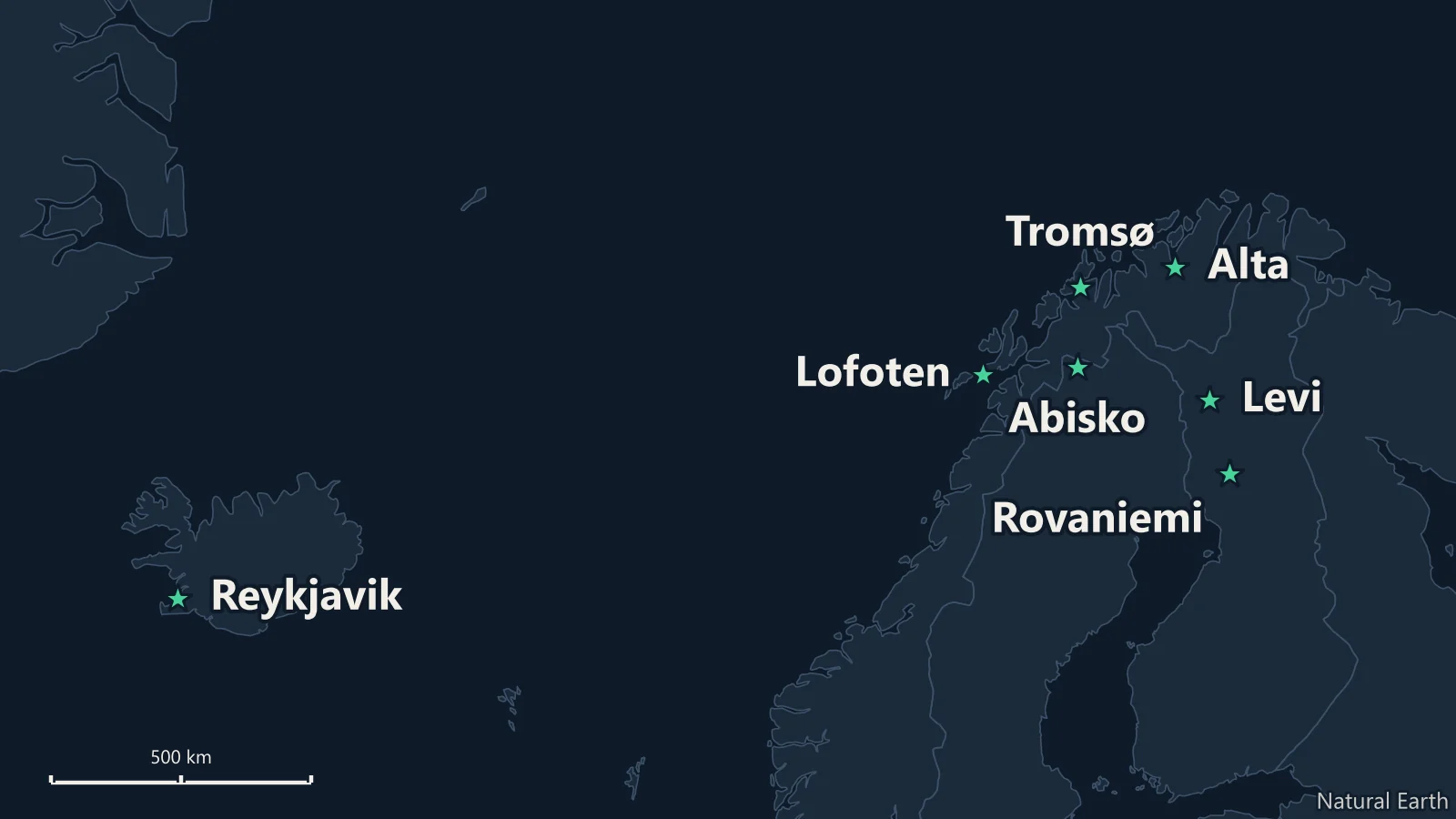
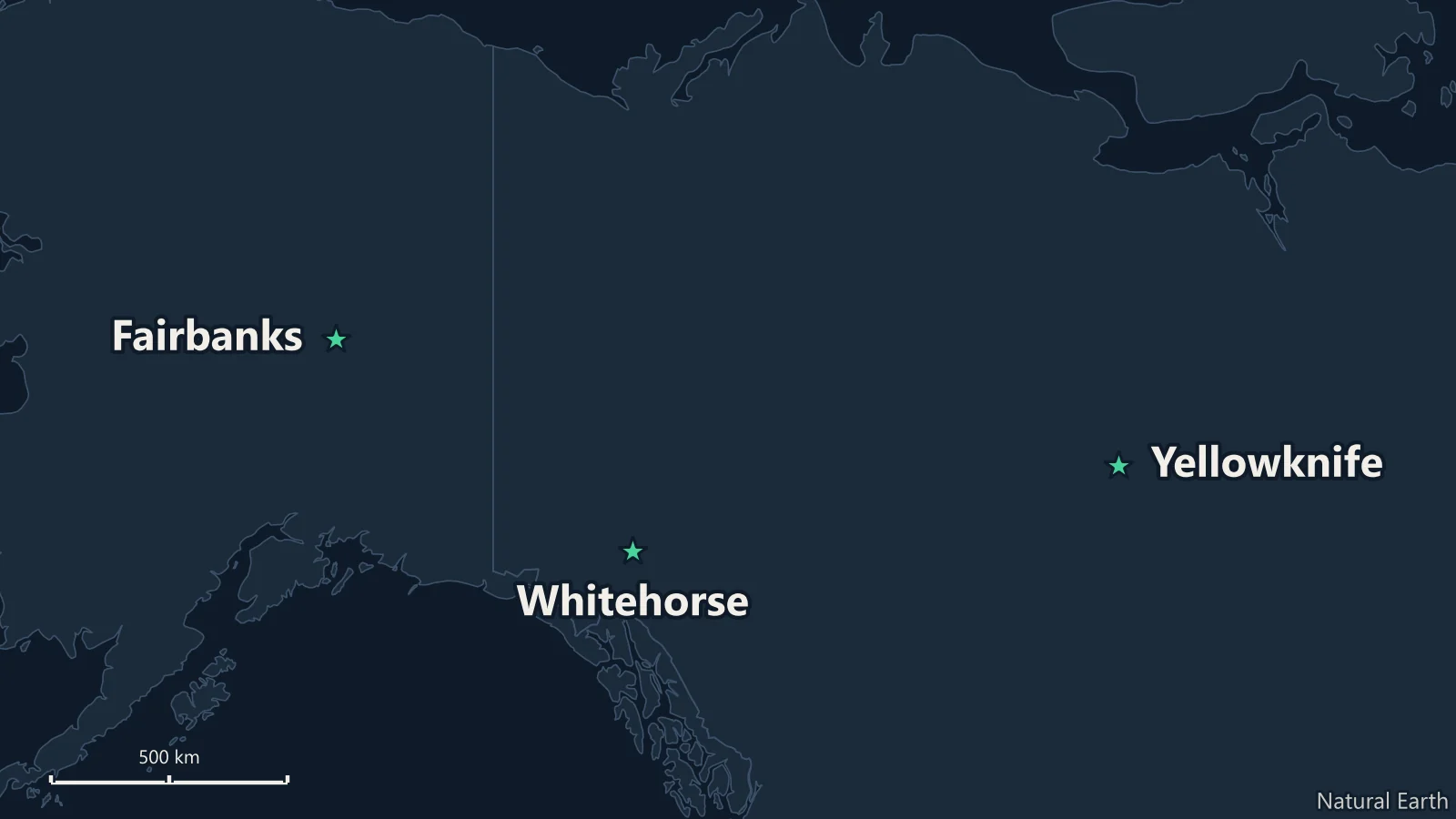
How the destinations are compared
Every figure on this site is computed for each destination’s own viewing site and dated. Darkness is the hours a night with the sun more than 12° below the horizon, computed with JPL’s DE421 ephemeris. Night cloud is NASA POWER’s night-time cloud climatology for 2001 to 2025. Geomagnetic latitude is the corrected geomagnetic latitude of the nearest INTERMAGNET observatory as ISGI publishes it (IGRF-13), adjusted for the distance to the viewing site, and the Kp needed follows NOAA’s rule of thumb: the oval’s edge sits near 66° geomagnetic at Kp 0 and moves about 2° towards the equator for each Kp step, an estimate. Activity is the share of dark three-hour windows from 2015 to 2025 with a Kp index of 3 or more, from the GFZ Kp index. Each destination page also reads tonight’s cloud forecast and NOAA’s Kp forecast live.
When to go
The season runs from about September to March or April, while the nights are dark. The weeks around the equinoxes, September and March, are the most active: across the European destinations, 30% of dark hours in September had Kp 3 or more in 2015 to 2025, against 18% in January. Midwinter has the longest nights. Month by month: September, October, November, December, January, February, March and April, or the best time to see the northern lights.
Is 2026 a good year?
Yes. NASA and NOAA announced in October 2024 that the Sun had reached the maximum period of its 11-year cycle, and the years just after a maximum are often as active. In the GFZ Kp record, 39.3% of 2025’s three-hour windows reached Kp 3 or more, the most since at least 2008, and 2026 so far is at 26.4% (to 2026-10-21). Activity is now declining towards the next solar minimum, around 2030 on NOAA’s cycle forecast, but strong storms are still possible. Read is 2026 a good year for the northern lights.
Can you see them without a tour?
Yes: the aurora is free, the forecasts are free, and on a clear active night you can see it from the edge of every town on this site. What a guided tour adds is the part that usually decides a trip: a guide who reads the cloud and the aurora forecast every evening and drives to the clear sky, sometimes for hours or across a border; a warm vehicle, thermal suits and hot drinks for the wait; photos of you under the lights; and, on many tours, a free retry or a refund if the sky stays shut. The most-reviewed tour on this site, Northern Lights Bus’s tour from Reykjavik, includes a free follow-up tour if you see nothing.
More: Norway or Iceland, the cheapest place to see the northern lights, what a trip costs, the Kp index explained and photography settings.
Before You Book
Six Things to Know Before a Northern Lights Tour
Cloud, darkness and timing decide the night more than the tour does.
Book Early in Your Stay
Cloud cancels some nights. Book the first or second evening, so a free retry or a rebooked night still fits your trip.
Cloud Is the Real Forecast
Under the oval the aurora is often there; cloud is what hides it. Each destination page reads tonight's cloud forecast from MET Norway beside NOAA's Kp forecast.
Stay Up Around Midnight
NOAA's Space Weather Prediction Center says the best aurora is usually within an hour or two of midnight, between 10 pm and 2 am local time.
Mind the Moon
A full moon lowers the apparent brightness of the aurora, though not its actual brightness. Strong displays still show; faint ones fade.
Dress for Hours Outside
Much of a chase is standing still in the cold. Several tours lend thermal suits or overalls; the comparison tables show which.
Read the No-Lights Policy
Policies differ: a free retry in Iceland, a refund if the camera catches nothing in Rovaniemi, none at all on some tours. Each page lists them.
FAQ: Northern Lights Destinations
Where, when and how much, from the ten places compared on this site. Figures checked October 2026.
On clear sky, Fairbanks (Alaska); in Europe, Abisko and Kiruna (Sweden). Both sit under the auroral oval; ranked by average clear dark hours a night in each place's best month, North America has roughly twice the Scandinavian coast. See the best places to see the northern lights.
Reliably, only in Alaska. Fairbanks sits under the oval at 65.0° geomagnetic latitude. The northern states see the lights on strong nights: on NOAA's rule of thumb, Minneapolis needs around Kp 6 and Seattle around Kp 7 (estimates). See Alaska.
Iceland is the easier trip; Norway has more tours and, inland at Alta, a little more clear sky. Both sit under the oval. Read Norway or Iceland.
September to March, with the equinox months the most active and midwinter the darkest. Across the European destinations, 30% of dark hours in September had Kp 3 or more in 2015 to 2025, against 18% in January. See the best time to go.
Yes, on the data so far. The Sun passed its maximum period in 2024 and activity stays high in the years after; it is now declining towards the minimum around 2030, but strong storms are still possible. Read is 2026 a good year.
On tour prices, Sweden and Finland. Kiruna's cheapest aurora tour starts at about US$32 and Rovaniemi's guarantee tours at about US$67 (October 2026). Flights and hotels decide most of the bill. See the cheapest place.
The tour itself starts at about US$32 in Kiruna and runs to several hundred for a full day in Alaska (October 2026). See what a northern lights trip costs.
Under the oval, almost none. In Iceland, Tromsø, Abisko, Alta, Yellowknife and Fairbanks, NOAA's rule of thumb puts the oval overhead at Kp 0 to 1; further south you need more. See the Kp index explained.
Red and blue-violet are rarer to the eye than green. Green, from oxygen around 100 to 300 km up, is by far the most common; the deep reds high up and the blue-violet fringes show mostly on strong nights, and a camera picks them up more readily than the eye.
The aurora is the same everywhere; the setting changes. For mountains and beaches under the lights, Norway's Lofoten islands and Iceland; for frozen lakes and forest, Lapland and Yellowknife.
Still have questions? Email us at info@northernlightsdestinations.com
Every Northern Lights Tour on This Site
Every tour on one page, from a Reykjavik bus with a free retry to an Arctic Circle day trip from Fairbanks.
From prices as of October 2026. Most tours cancel free up to 24 hours ahead; cloud can cancel a night, and many operators then rebook you or refund.